
Responsive Search Ads: A Practical Guide for 2026
Learn how responsive search ads work, why they matter in 2026, and proven ways to write headlines, measure performance, and lift conversions.
responsive search ads, RSA best practices, Google Ads, ad copy, ad strength
A responsive search ad lets Google mix and match up to 15 headlines and 4 descriptions to find the highest-performing combination for each search. You provide the ingredients, and Google assembles the version most likely to fit the query and the user.
But if the system writes the final combination, what exactly are you responsible for? The common answer is “add more headlines.” That advice misses the harder problem: how do you govern the messages, placements, approvals, and reporting that sit around those headlines?
Responsive search ads are no longer just a copy format. They’re a creative operating system inside Google Ads. The advertisers who get the most from them don’t surrender strategy to automation. They build a strong, varied asset library, give the system room to test, and create rules for who owns each message.
Table of Contents
- What Responsive Search Ads Are and Why They Matter in 2026
- How Google’s Combination Testing Actually Works
- Writing Headlines and Descriptions That Perform
- How Many RSAs Per Ad Group Is Enough
- When More Assets Stop Helping
- Measuring RSA Performance the Right Way
- Governing Assets Across Accounts and Placements
- A 30-Day RSA Review Checklist
What Responsive Search Ads Are and Why They Matter in 2026
A responsive search ad, or RSA, is one ad made from a collection of headlines and descriptions. Instead of choosing one fixed headline sequence, you submit multiple assets and allow Google’s system to assemble different combinations for different searches.
Think of a tasting menu. Your team supplies the ingredients: a product benefit, a proof point, a price message, a service promise, and a call to action. Google acts like the chef, selecting a combination that fits the searcher and the auction context. The chef can’t invent a good ingredient you never supplied, though. Automation can arrange your messages, but it can’t repair a weak or repetitive message library.
Google introduced RSAs in 2018. After Expanded Text Ads were phased out, RSAs became the only way advertisers could create search ads in Google Ads, according to Optmyzr’s analysis of responsive search ad adoption and performance. That makes RSA fluency a basic buying skill, not an advanced tactic reserved for large accounts.
The operating model has changed
For a 2026 workflow, don’t think of an RSA as a finished ad with optional variations. Think of it as a managed pool of reusable creative assets. Each headline has a job, and each description should add information rather than repeat the same promise.
That shift matters because teams now work across more layers:
- Ad-level assets contain the headlines and descriptions submitted inside the RSA.
- Campaign-level text assets can sit outside the ad itself and may be governed separately.
- Extensions and other assets can affect what users see alongside the primary ad.
- Shared libraries create reuse across campaigns, brands, markets, and account structures.
Google’s system tests combinations over time and favors headline and description pairings that work well together. The practical lever isn’t blind volume. It’s message diversity plus enough eligible traffic for the system to learn. Google’s RSA API documentation describes the format as a combination of multiple headlines and descriptions evaluated for serving.
For example, a running-shoe advertiser might submit headlines about price, comfort, trail grip, fast delivery, and returns. A search for affordable running shoes may receive the price and delivery angle. A search for trail running shoes may receive trail grip and durability. The advertiser didn’t create two separate fixed ads, but the asset library still needs to cover both intents.
If you’d like broader context on how automation fits into paid search workflows, this guide to AI for Google Ads is a useful companion. The important distinction is that automation should expand testing and execution, not replace positioning decisions.
How Google’s Combination Testing Actually Works
Suppose a shoe retailer builds one RSA for a category that includes road, gym, and trail runners. The team supplies headlines such as:
- Affordable Running Shoes
- Built for Daily Miles
- Trail Grip for Rough Paths
- Free Delivery on Orders
- Easy Returns Available
- Shop Men’s Running Shoes
- Shop Women’s Running Shoes
- Find Your Best Fit
- Cushioned for Long Runs
- Lightweight Training Shoes
The descriptions can explain fit guidance, delivery, returns, and product selection. Google then evaluates eligible combinations against the search and auction context. The system does not just rotate the assets evenly. It learns which pairings are more useful for different users and gives stronger combinations more opportunity to serve.
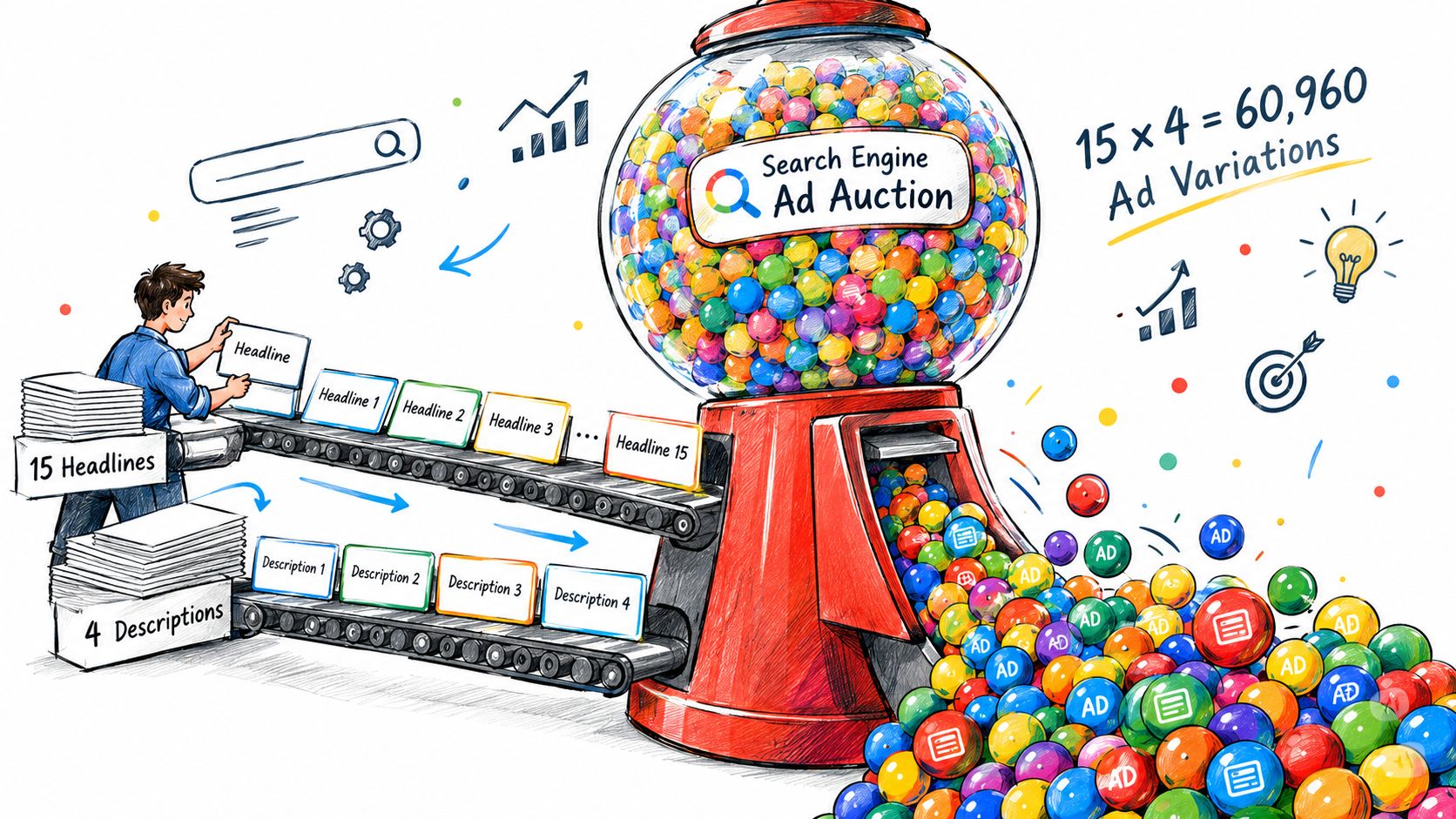
One asset pool, different search intent
A person searching for affordable running shoes has signaled a price concern. The system may favor “Affordable Running Shoes,” “Free Delivery on Orders,” and a description explaining value or purchasing confidence.
A person searching for best trail running shoes has given a different signal. “Trail Grip for Rough Paths,” “Cushioned for Long Runs,” and a description about terrain or durability may be more relevant.
The advertiser’s job is to provide enough truthful options for both situations. The system’s job is to identify a suitable combination from those options. That doesn’t mean every possible pairing is useful. Google filters combinations that can’t serve, including combinations affected by policy, format, or pinning constraints.
What the buyer controls
You control the inputs and the boundaries:
- The claims, such as price, materials, availability, or service.
- The intent coverage, such as budget, category, product, and problem-focused searches.
- The order constraints, if a legal or mandatory message must appear in a particular position.
- The review process, including brand, legal, and policy approval.
- The measurement plan, which determines whether a combination is helping the business.
Google controls the auction-time selection. It uses signals connected to the query, the user, the device, and the available ad opportunity. You won’t see every internal decision, so your reporting should focus on patterns rather than trying to reconstruct every unseen combination.
A useful mental model is a restaurant with a changing menu. If every ingredient tastes the same, the kitchen has no meaningful choices. If the ingredients are varied but incompatible, many plates won’t work. The strongest RSA libraries offer distinct, compatible messages that can be combined without changing the truth of the offer.
Writing Headlines and Descriptions That Perform
Good RSA assets are short, specific, and independently useful. Each headline should communicate one clear idea, because Google needs to combine it with other assets without creating an awkward or contradictory sentence.
For a meal-delivery service, these are distinct ideas:
- Healthy Meals Delivered
- Plans for Busy Weeknights
- Choose From Flexible Menus
- Skip or Cancel Anytime
- Order by Friday
- Try Your First Box
These are not six versions of one headline. They cover the product, audience situation, flexibility, deadline, and action.
Write for both people and the system
Put the most important meaning early. A user scanning a search result should understand the benefit before reaching the end of the line. A keyword can help establish relevance, but repeating the keyword across every asset doesn’t create useful variety.
Use the asset library to cover different message roles:
- Category relevance: what the product or service is.
- Customer outcome: what improves for the buyer.
- Proof or reassurance: why the buyer should trust the offer.
- Commercial detail: delivery, pricing, availability, or terms.
- Action: what the user should do next.
Descriptions have more room to explain the relationship between those ideas. A description might connect a benefit to a reason to believe, while another handles objections or sets expectations.
The documented field limits are 30 characters per headline and 90 characters per description, with up to 15 headlines and 4 descriptions available in an RSA, as outlined in Google’s responsive search ad guidance. Treat those limits as an editing discipline. If a sentence only works after several clauses, it probably contains more than one message.
Practical rule: Write one strong asset for each unique value proposition, not five near-duplicates with different punctuation.
Pinning can help when a message must appear in a defined position, such as regulated wording or a required disclaimer. Outside those cases, heavy pinning reduces the system’s ability to test combinations. Before pinning, ask whether the constraint protects compliance or merely reflects a preference for a fixed layout.
Use Ad Strength as an editor, not a scoreboard
Ad Strength provides feedback while you build an RSA. Its ratings, from Poor through Excellent, reflect whether the system sees enough relevant and varied material to work with. It can surface issues such as missing keyword relevance, weak calls to action, or redundant assets.
That makes it useful as a diagnostic prompt, not a substitute for performance data. A higher rating doesn’t prove that an ad will produce profitable conversions, and a lower rating doesn’t automatically mean the copy is strategically wrong. Read the recommendation, then decide whether the suggested change improves the message for a human searcher.
For a deeper discussion of how to develop persuasive, clear advertising language, see this resource on writing high-converting ads. Apply that human-first discipline before trying to satisfy an automated meter. You can also see how asset-based workflows change campaign organization in this overview of bringing your own creative into Google Ads workflows.
| Element | Limit | Per ad | Pinning guidance |
|---|---|---|---|
| Headline | 30 characters | Up to 15 | Pin only when a position is necessary |
| Description | 90 characters | Up to 4 | Keep messages distinct and compatible |
How Many RSAs Per Ad Group Is Enough
The right number depends on whether each RSA adds a genuinely different message system. Creating another ad that repeats the same headlines usually adds clutter, not coverage.
Google reports that improving RSA Ad Strength from Poor to Excellent is associated with 15% more clicks and conversions on average, while adding a second RSA in the same ad group is associated with a 6.6% conversion lift at similar CPA, and a third adds another 3.7% conversion lift, as documented in Google’s RSA recommendations. These figures are directional guidance, not a promise for every account.
A single RSA can be a sensible control when the ad group is tightly themed and its assets cover the main intent. A second RSA becomes useful when you want to test a different framing without replacing the first. For example, one RSA might emphasize “same-day service,” while the second emphasizes “transparent pricing.” The landing page and targeting should still support both messages.
A third RSA can fill a real coverage gap. An ecommerce account might use one ad for core product benefits, one for a seasonal offer, and one for a high-intent category angle. The distinction must exist in the strategy, not only in the ad name.
| RSAs in ad group | Average incremental click lift | Average incremental conversion lift | When it makes sense |
|---|---|---|---|
| One | Baseline | Baseline | The ad group has one coherent intent and a varied asset pool |
| Two | Not specified in the cited guidance | 6.6% | You need a second value proposition or audience framing |
| Three | Not specified in the cited guidance | Another 3.7% | A third message mix fills a clear coverage gap |
Treat three as a practical ceiling for a tightly themed ad group, not a universal law. Add another only when the ad group contains distinct product lines, geographies, funnel stages, or commercial conditions that deserve different copy.
The model can combine assets across the RSAs in an ad group, so overlapping libraries weaken the reason for adding another ad. Before creating RSA four, compare the proposed asset pool with what already exists. If the new ad doesn’t introduce a new customer promise, it probably belongs in an edit or controlled test instead.
When More Assets Stop Helping
“Fill every available slot” sounds sensible until you inspect the wording. Fifteen headlines that all say “quality products,” “high-quality products,” and “shop quality products” don’t give Google fifteen meaningful choices. They give the system several ways to repeat one idea.
Google’s documentation describes duplicate and redundant combinations being removed before eligible combinations advance toward serving. That creates a governance question: what new meaning does this asset add?
Consider a retailer with these headlines:
- Free Shipping on Orders
- Get Free Shipping Today
- Enjoy Free Shipping Now
- Free Shipping Available
- Shop With Free Shipping
If the underlying offer and message are the same, the library has gained wording but not strategic diversity. A better set might cover delivery, returns, product range, fit support, and a category benefit. Those messages can work together without competing for the same role.
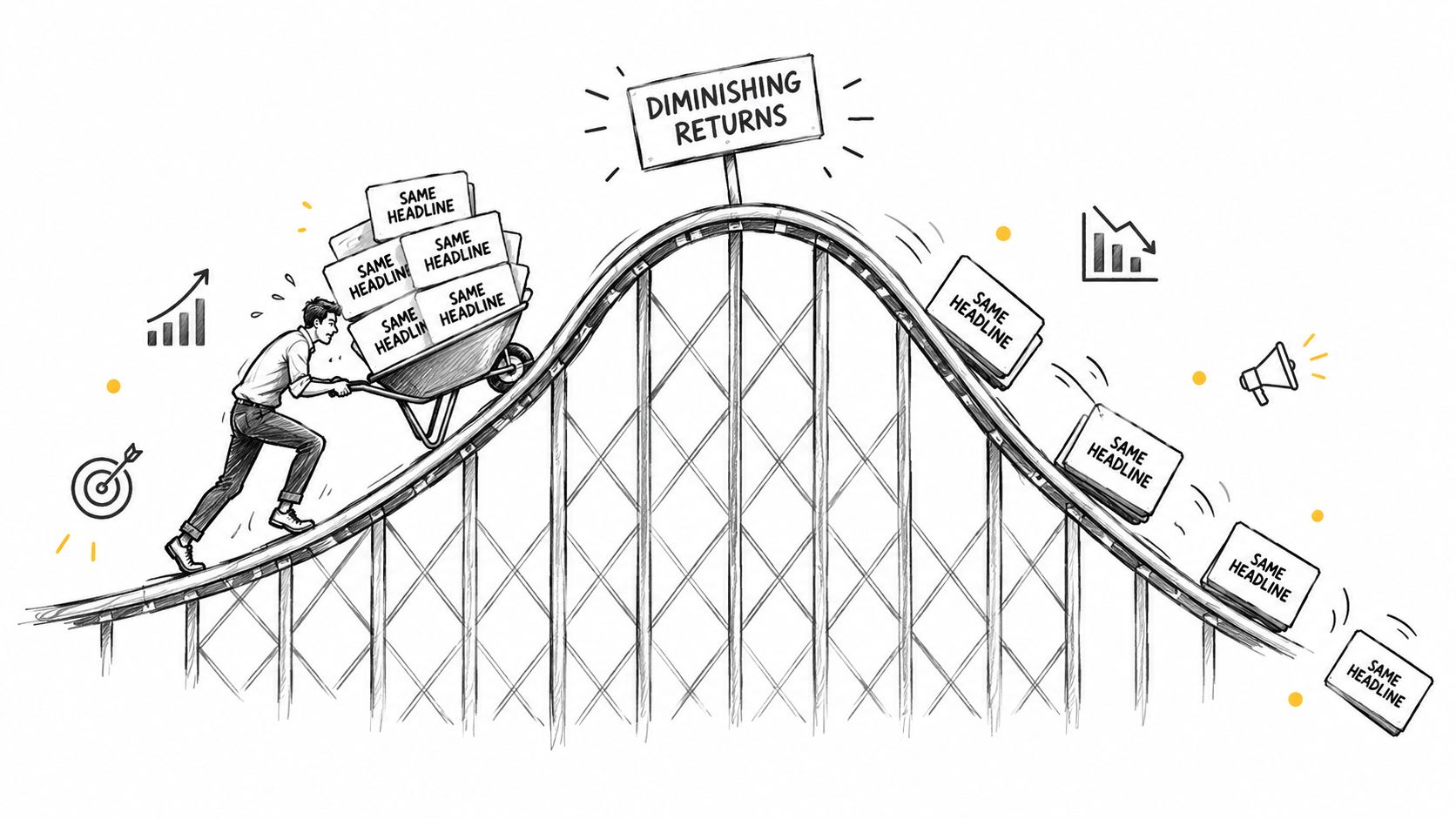
A stopping rule for creative teams
Teams often keep adding assets because the interface rewards activity. That can make the account look busy while leaving the underlying proposition unchanged. Similar assets also make asset reports harder to interpret, because performance gets distributed across messages that users experience as nearly identical.
Stop expanding the library when these conditions line up:
- The message roles are covered: product, benefit, proof, objection handling, and action all have credible assets.
- Ad Strength is Good or better: the system no longer flags obvious inventory or diversity gaps.
- The asset report shows usable separation: some assets are clearly stronger or weaker than others.
- New drafts add meaning: proposed headlines introduce a new intent or promise rather than a synonym.
- Policy review is clean: the combinations don’t create avoidable approval problems.
If a brand adds a full set of headlines and Ad Strength plateaus at Good while conversion performance stays unchanged, the next move shouldn’t be another synonym. Review the landing page, query intent, offer, budget, and ad-group structure. Creative volume can’t solve a mismatch between what people search for and what the page delivers.
Measuring RSA Performance the Right Way
An RSA needs several measurement layers because no single Google Ads column explains whether the system is helping. Ad Strength tells you about inventory. Asset reporting shows which inputs received useful exposure. Business metrics tell you whether the traffic was valuable.
Start with the diagnostic layer
Use Ad Strength as a leading indicator and an editorial brief in reverse. If the rating is Poor, inspect the missing ingredients. Are the headlines all versions of the same claim? Is the main keyword absent? Does the description explain a benefit and a next step?
Don’t optimize the account toward Excellent without reading the copy. A forced headline can satisfy the interface while making the ad less persuasive or less accurate.
The asset performance report adds another view. Google labels assets according to how they perform within the combinations that appeared. Use those labels as decision aids:
- Best: preserve the asset, then consider it for a controlled variation or new intent group.
- Good: keep it when it covers a distinct role or audience need.
- Low: investigate whether the asset is weak, poorly matched to the ad group, or underexposed before pausing it.
A Low label isn’t automatically a verdict. An asset may have limited opportunity or may be useful for a niche query. Look at the surrounding query and landing-page context before removing it.
Connect asset evidence to business outcomes
The next layer is auction and delivery data. Check impression share, absolute top rate, eligible combinations, and whether the ad group is constrained by budget or ranking. These metrics help explain why a strong asset library may not receive enough opportunities to show.
The final layer is the lagging business view:
- Conversion rate
- Cost per acquisition
- Conversion volume
- Revenue or qualified lead quality
- Incremental movement against a suitable comparison
Don’t call an RSA a winner because its Ad Strength improved. Call it useful when the ad group attracts the right users and contributes to a sustainable business result. Google’s reported RSA lifts are associations, so treat them as a reason to test, not as a guaranteed forecast.
For a practical glossary of the numbers that matter in ad operations, use this guide to ad performance metrics. Then define the review window before you make changes. A monthly review gives the asset library time to collect enough observations while keeping decisions frequent enough for the team to learn.
Governing Assets Across Accounts and Placements
An RSA headline may begin as a line in one ad group, but the same idea can influence other parts of the account. Google announced in July 2026 that it automatically features RSA headlines in the sitelink section while respecting pinned controls, according to its announcement about Google Ads asset reuse. That changes the old assumption that a headline only competes inside the primary ad unit.
The governance implication is straightforward: an asset needs an owner before it needs more variations.
Build a shared inventory
An agency or multi-brand team should maintain a master asset pool with fields such as:
- Brand and market
- Product or service
- Intent category
- Message role
- Approved wording
- Legal restrictions
- Landing-page destination
- Owner and approval date
- Active, testing, or retired status
This inventory prevents a common failure mode: one account manager writes a local version of the offer, another team publishes a conflicting promise, and a reused asset reaches a placement nobody considered during the original review.
Campaign-level text assets add another layer of responsibility. They are separate from ad-level RSAs and aren’t factored into Ad Strength, yet they still undergo policy review when created. Teams should therefore avoid treating every asset as interchangeable. Decide which layer owns core positioning, which layer owns navigation, and which layer handles temporary promotions.
Keep approval centralized and proposals distributed
A thin ownership model works better than either extreme. One lead should curate the master library and maintain naming and versioning rules. Account managers, copywriters, and market specialists can propose additions because they’re closest to search behavior. A central brand or legal owner should approve claims before publication.
That structure also reduces political friction. Agencies don’t need to hide copy inside individual accounts, and in-house teams don’t need to approve every minor variation manually if the approved message roles are clear. The team can move quickly without losing accountability.
AdCrunch is one operational option for teams that need to query Google Ads structure and performance through connected AI agents while keeping account changes in a recorded workflow. Whatever tool you use, the principle stays the same: creative governance should survive account handovers, new markets, and new placements.
A 30-Day RSA Review Checklist
A monthly RSA review works best when each week has one job. Don’t rewrite every asset at once. Preserve a control, record the reason for each change, and make the next review answer a specific question.

Week one for diagnosis
Open the Ads and assets area in Google Ads and review every RSA’s Ad Strength. Flag ads rated Poor or Average, but don’t replace them automatically. Record the missing recommendation, the ad group’s central intent, and whether the proposed fix would add a new message.
Pull the asset performance report and save the current labels. Your shared sheet should include the campaign, ad group, RSA name, asset text, role, label, landing page, and next action.
Week two for deliberate editing
Review Low assets alongside the search terms and landing page. Replace an asset when it is persistently weak, redundant, inaccurate, or misaligned with the query. Keep a useful Low asset when it covers an important niche that hasn’t received enough exposure to judge fairly.
Create a change log with three fields: what changed, why it changed, and what result would justify keeping it. This prevents the team from confusing activity with learning.
Week three for governance
Audit shared text assets, sitelink relationships, pins, and approval status. Ask whether a headline still says what the brand wants users to see when it appears outside the primary RSA arrangement.
Check for repeated value propositions across RSAs. If three ads all depend on the same “fast delivery” message, decide whether the account needs more product or customer-outcome coverage instead.
Week four for evaluation
Compare conversion rate, CPA, conversion volume, impression share, and relevant quality signals with the previous review period. Don’t force a conclusion if delivery conditions changed. Record whether the evidence supports keeping the edit, reverting it, or testing a new hypothesis.
When nothing changed, ask:
- Is impression share limited by budget or rank?
- Are pins restricting useful combinations?
- Are the headlines repeating one value proposition?
- Did the landing page support the promise?
- Did the edited assets receive enough eligible exposure to evaluate?
Finish with a hand-off note containing the asset changes, report readout, unresolved question, and next test hypothesis. That simple record preserves institutional memory when a buyer, agency, or market owner changes.
Use this checklist to turn responsive search ads into a governed creative program rather than a pile of interchangeable copy. AdCrunch connects Google Ads account structure and performance to AI-assisted workflows, so teams can investigate RSA results and manage related operations from a shared process. Visit AdCrunch to see how it can fit into your multi-account advertising workflow.